Brand Audit
You built this brand
with your eye.
Every font. Every campaign. Every page. You saw it first. You knew when it was right.
That eye is why the brand works. It is also the problem.
An investor opened your website yesterday. She has reviewed 340 brands this year. She formed her opinion before she finished reading your headline.
You were not in the room.
Most founders who work this hard on visual consistency believe the same thing.
I have good taste. That is why the brand works.
This is true. And it is the problem.
Every brand consultant alive will tell you the solution is better guidelines. A thicker brand book. A more detailed style guide. This advice has been given for decades. It does not solve the problem.
The problem is not that the standard does not exist on paper. The problem is that it exists in you. Your approval. Your eye. Your presence in the room. When you leave the room, the brand drifts.
That drift has a name. Investors call it key person risk.
The study most founders have never seen
In a study by Beauty Independent, three institutional investors were each asked to value three beauty brands. The brand with the most exquisite packaging was valued lowest by all three.
The investor's note: "We can probably still improve the packaging."
Beautiful is not what they pay for.
They pay for one thing: evidence that the standard survives the founder. When that evidence is absent, a discount between 10% and 40% is applied to the offer before it is written. The founder is not told this is happening.
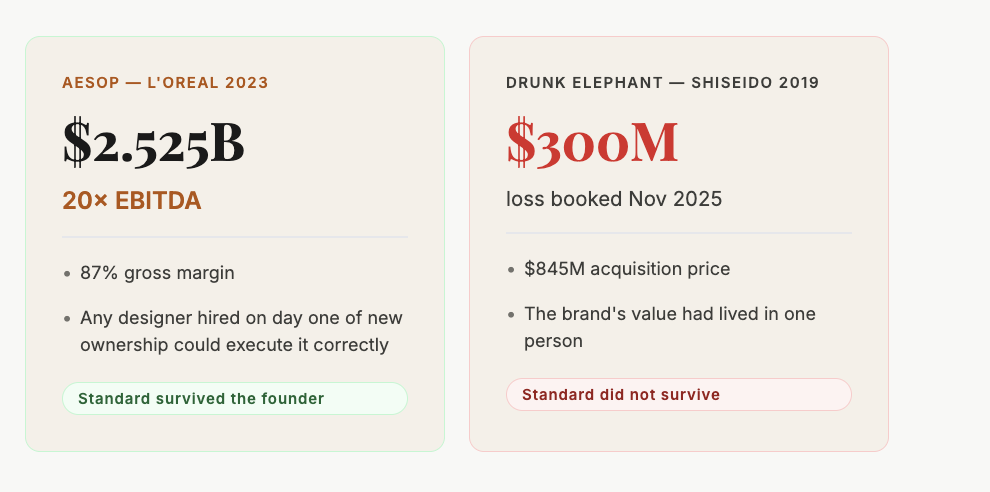
Two of the 14 brands in this audit are ones you know. One was acquired for more than $1 billion. One generated a $300 million loss for its acquirer. The only measurable difference between them was whether the standard could be enforced without the founder in the room.
What founders actually mean
You have said one of these things. Here is what you meant.
What she says
"I need a rebrand."
What she means
I feel like my brand stopped being mine and I don't know when that happened.
What she says
"I need brand guidelines."
What she means
I have a designer who keeps asking me questions I shouldn't have to answer every time.
What she says
"I want to be investor ready."
What she means
I want to walk into that room and not feel like a fraud who built something pretty but not something defensible.
What she says
"My brand feels inconsistent."
What she means
I am the only enforcement mechanism and I am exhausted.
What she says
"I don't know what buyers are looking for."
What she means
I'm terrified the thing I built doesn't pass a test I haven't seen yet.
The audit below is the rubric. She has been preparing for this room without knowing it existed. You are about to see it for the first time.
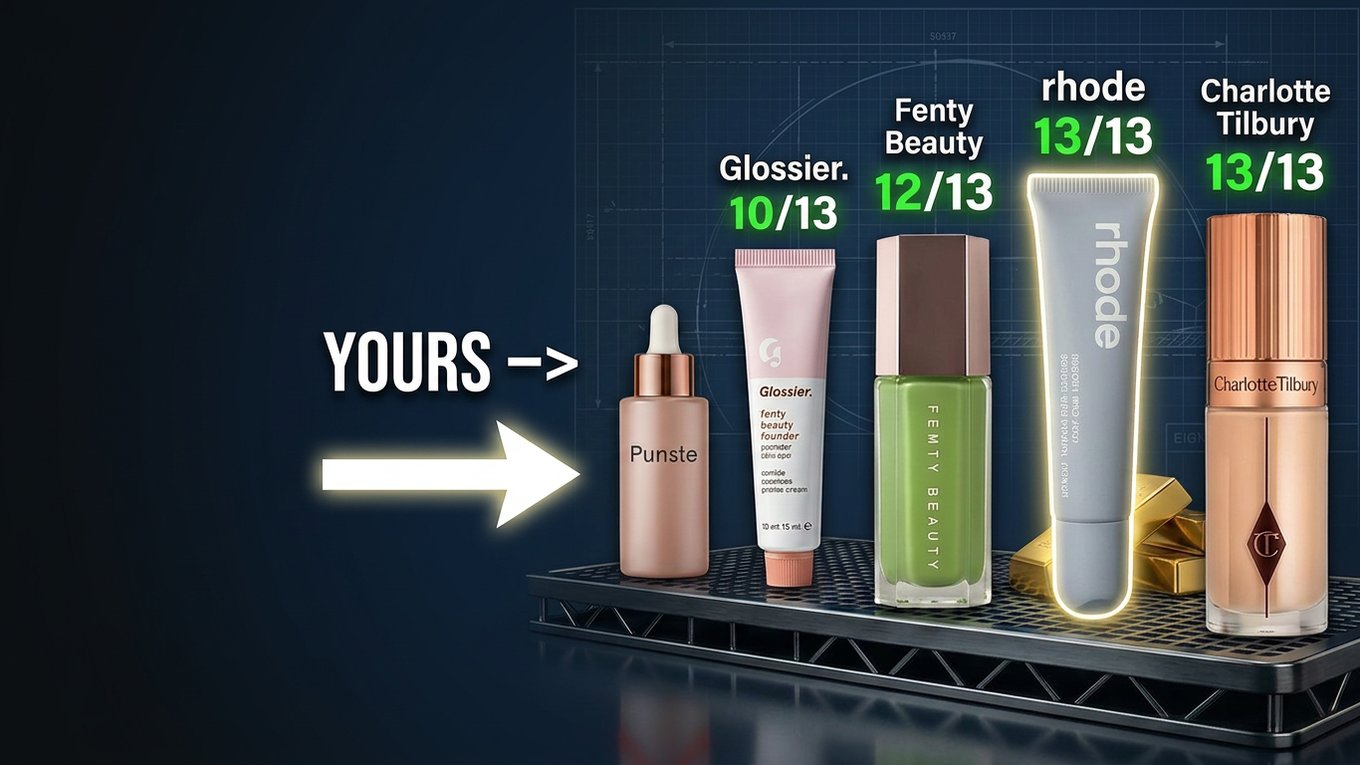
This is where known brands score. The audit below tells you where yours does.
The forensic audit
14 brands. Every exit outcome between 2019 and 2025.
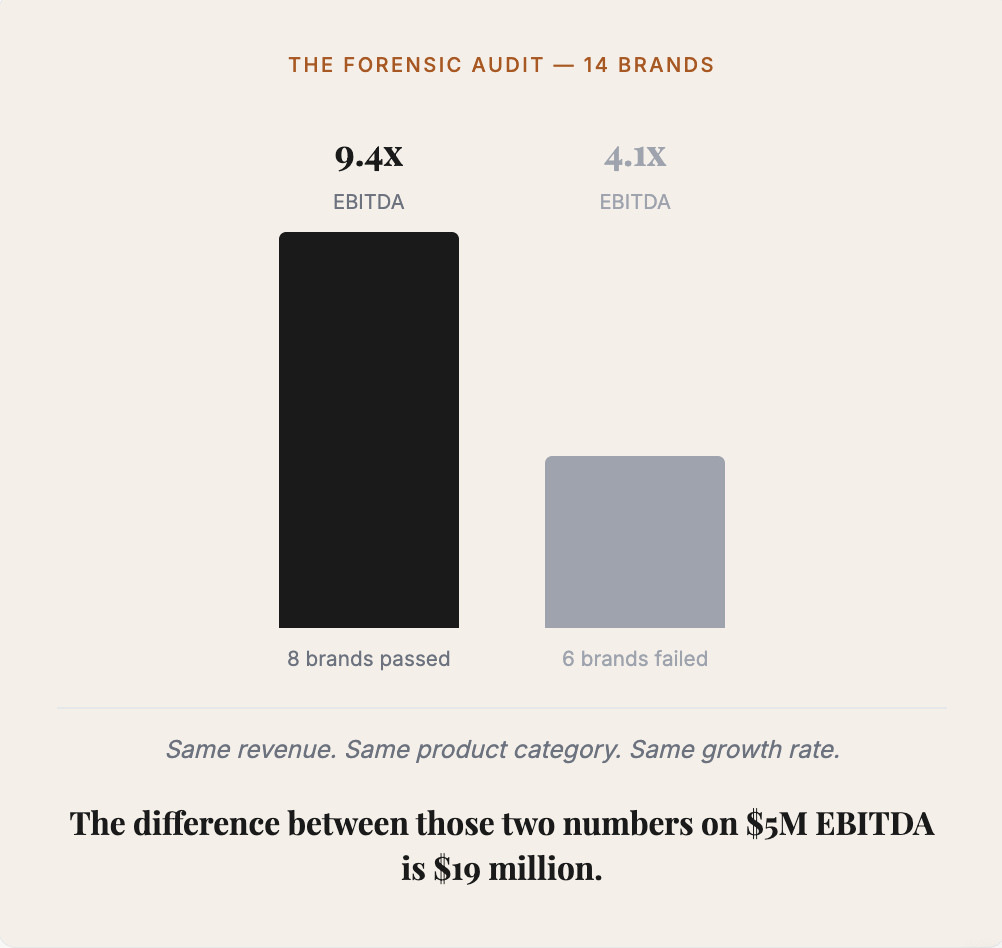
Same revenue ranges. Same product categories. Same growth rates. The difference was not what they built. It was whether what they built could survive without the person who built it.
Why these 13 laws are not opinions
The 13 Visual Laws are derived from two sources: documented conversion rate research, and pattern analysis of 14 brands that commanded between 8 and 12 times EBITDA at acquisition.
Four of the 13 carry direct external validation:
- Law 5 is the WCAG 2.0 federal accessibility standard. Literally the law.
- Law 6 is the finding of the Baymard Institute across 40,000 mobile sessions.
- Law 11 is documented in Meta's own advertising best practices.
- Law 12 is the enforced standard at Aesop, Tatcha, and La Mer. Not a suggestion.
Those four give the other nine their foundation.
The physics, stated flatly.
The Binary Gate is binary. An asset either passes or it fails. There is no mostly compliant. A score of 73 is the same as a score of 40. Both mean the gate was open. Buyers do not grade on a curve.
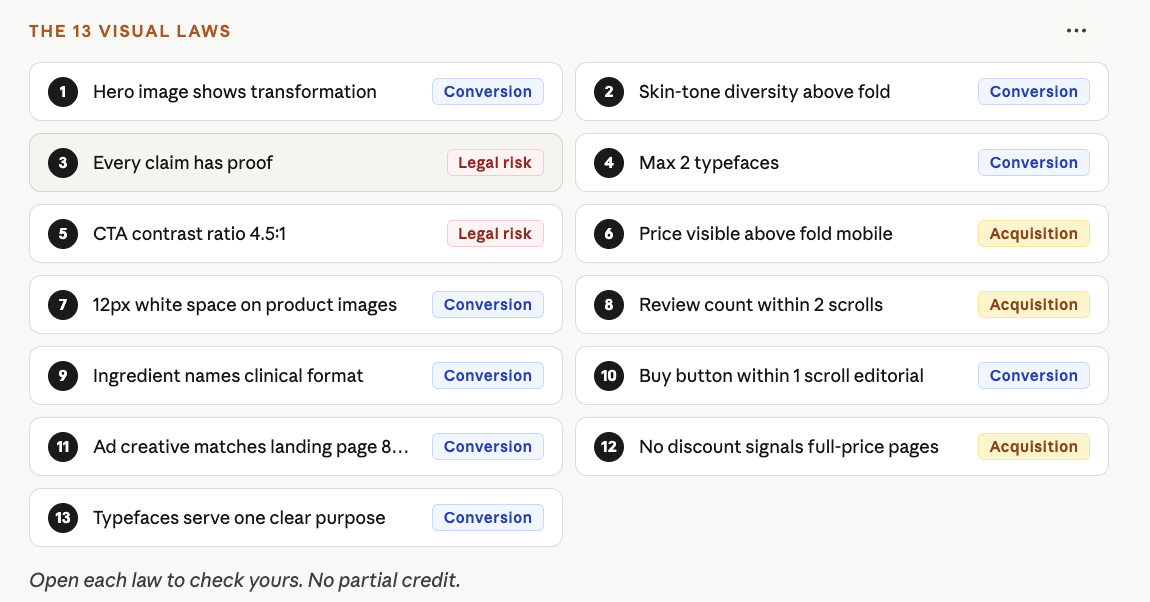
Open each law to check yours. No partial credit.
The question the audit cannot answer
The due diligence call takes four hours.
Two hours on financials. Forty-five minutes on operations. Fifteen minutes on brand.
In those fifteen minutes, one of the associates asks who approves assets when you are not available.
You say your creative director uses her judgment.
The associate writes something down. You do not see what.
Six weeks later the offer arrives. Your banker had modeled 9 times EBITDA. The offer is at 5.2 times.
On $5 million in EBITDA, the difference between those two numbers is $19 million.
You now know your Binary Gate score. You know which laws you passed and which you failed.
The audit cannot tell you which of your failures is the expensive one.
That depends on your revenue stage, your channel mix, your retail position, and where you are in your exit or fundraising timeline. That analysis requires 20 minutes and the specific facts of your brand.
The founders who book this call are not the ones who failed every law. They are the ones who passed enough to know the gap is closeable, and who want to know what it costs to close it. No pitch. No commitment. One question answered: which of your failures is the expensive one, and in what order do you close them.
Tell me which failure is the expensive one →Lauren Ratner built Rhode's visual standard before Hailey Bieber's name was on anything.
"We're a highly visual brand and I think that sets us apart."
Lauren Ratner, President and CBO, Rhode
e.l.f. acquired Rhode for $1 billion in May 2025. The fastest billion-dollar sale in beauty history.