For Investor Firms · VC · PE · Beauty & DTC
Brand governance is the risk your diligence checklist doesn't have a line for.
We built a scoring system that quantifies it across 13 measurable laws derived from 14 beauty brand acquisitions. It tells you what a brand's visual system signals about gross margins, operational independence, and key person risk.
Before you write the check. Or after, when a portfolio company needs the system installed.
The forensic audit
9.4× vs 4.1× EBITDA. Same category. Same revenue range. Brand governance explains the entire gap.
We audited 14 beauty brands against the 13 Visual Laws at the time of their acquisition conversations. Brands that passed the standard received multiples between 8× and 12×. Brands that failed received between 3× and 5×. The average gap across the cohort: 9.4× vs 4.1×.
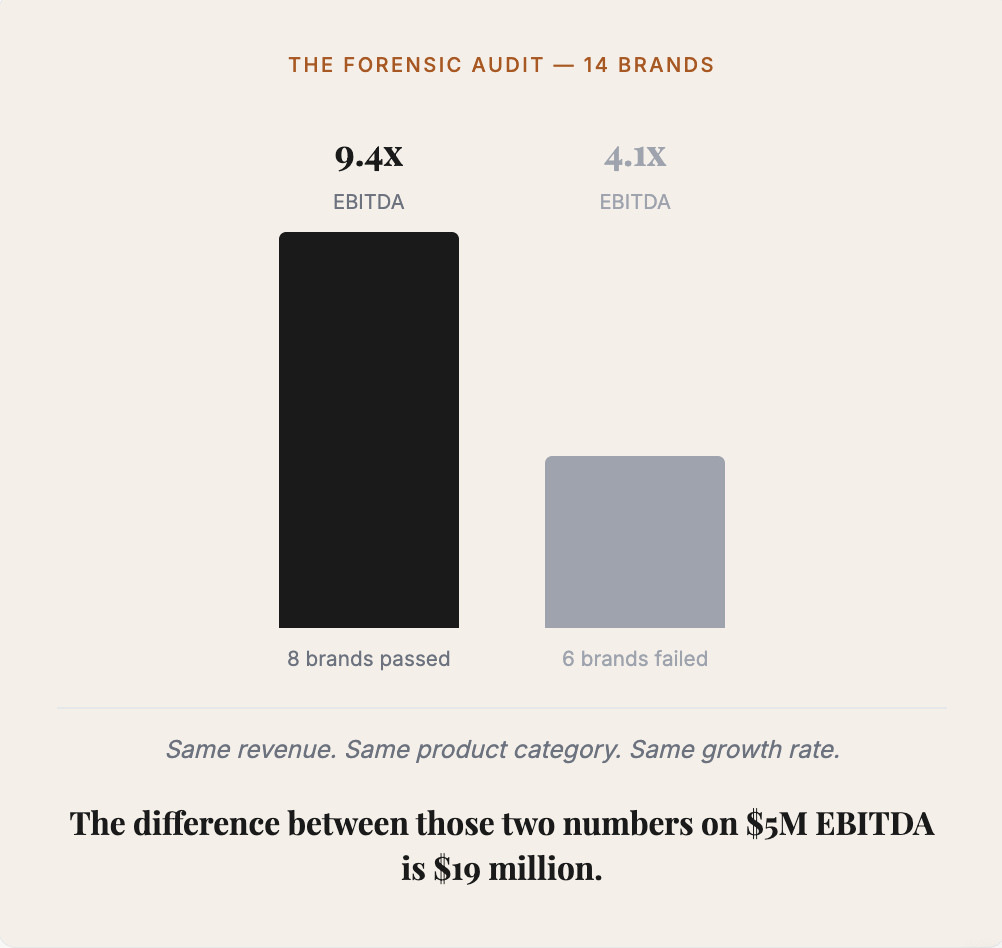
Brands that passed the standard
9.4×
Average EBITDA multiple at acquisition
Brands that failed the standard
4.1×
Average EBITDA multiple at acquisition
The gap in a single deal
$19M+
Same EBITDA. Different visual governance outcome.
Risk classification
The 13 Visual Laws map to three risk categories you already track.
Brand governance failures are not aesthetic problems. Each law violation is a signal in a risk category with a measurable dollar consequence.
ADA lawsuits against DTC brands increased 300% between 2019 and 2024.
A contrast ratio failure is a documented legal liability. Law 5 maps directly to the WCAG 2.0 federal standard. It is not a design preference. It has restructured closing terms.
Key person risk is priced at 4–6× EBITDA. Institutional brand standards trade at 8–12×.
Discount signals on full-price pages predict gross margin erosion before the P&L confirms it. Every brand with those signals in the forensic audit had gross margins below 62%. Every brand without: above 67%.
CAC inflation and LTV compression are visible in the visual system before the financial model catches them.
A hero image that shows the product instead of the transformation tells a diligence team this brand has not decided who it's talking to. That uncertainty shows up in paid acquisition cost within one quarter.
The core concern
A buyer doesn't buy the brand. They buy the system that runs the brand when the founder is no longer in the room.
If a portfolio company's content team asks "does this look right?" before anything ships, the brand standard is not institutional. It is personal. Personal brand standards have key person risk. Key person risk is priced at 4–6× EBITDA. Institutional brand standards trade at 8–12×.
The Binary Gate is what makes brand governance institutional: documented in writing, executable by any trained team member, enforceable without the founder's approval on every asset. After the system is installed, the founder's sign-off becomes optional, not mandatory. That shift is the difference between a brand that commands a strategic premium and one that gets discounted at the close.
The case study you already know
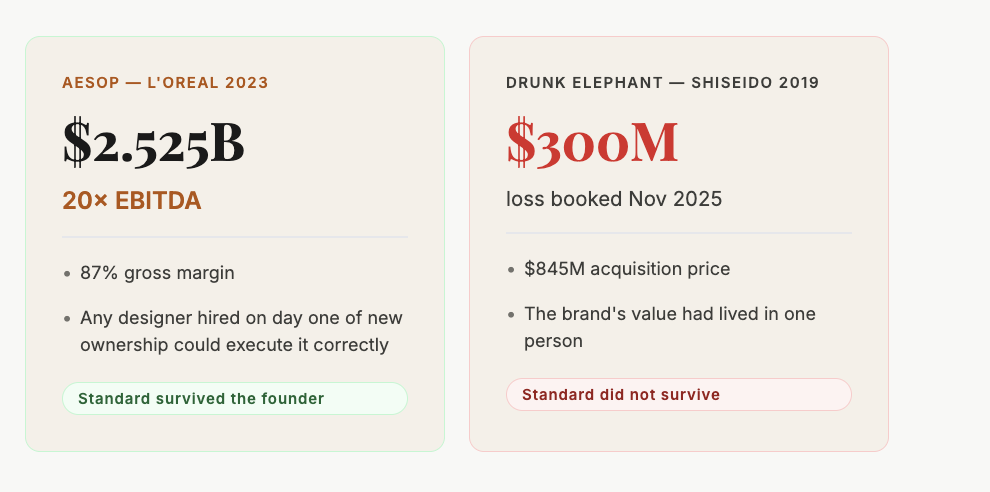
Same category. Same era. Aesop's brand standard survived every ownership transition: 9 countries, 4 ownership changes, 20× EBITDA at the Natura close. Drunk Elephant's standard did not survive the Shiseido transition. $300M write-down. The system is the asset.
Pre-close intelligence
The visual system tells you what the P&L confirms in year two.
Discount signals on full-price pages are a gross margin indicator that most diligence processes miss until the Year 2 cohort data arrives. In the forensic audit:
Every brand with discount signals on full-price pages
Below 62% gross margin
Every brand without discount signals on full-price pages
Above 67% gross margin
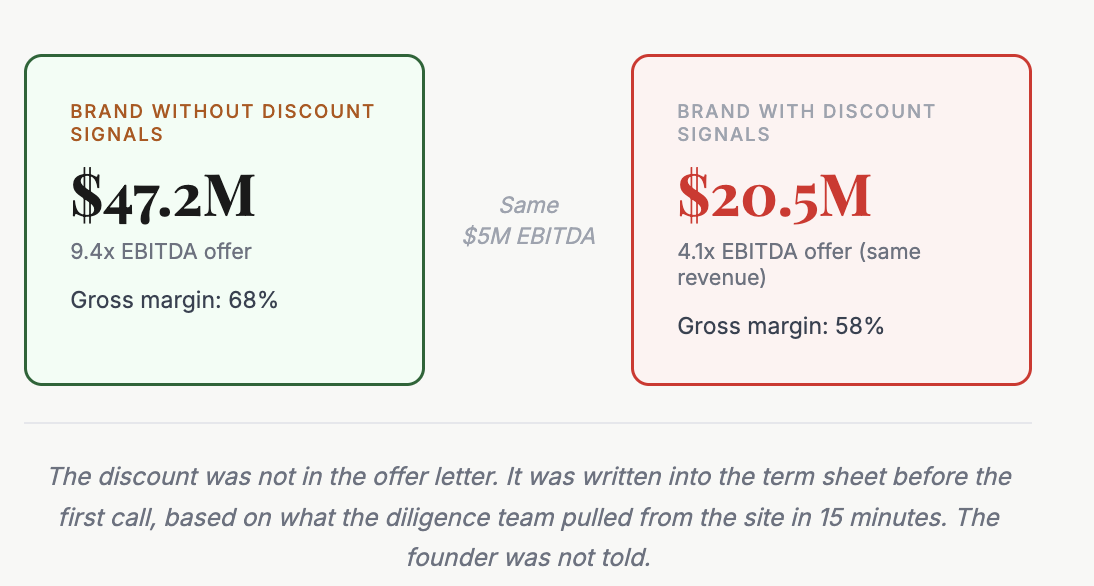
Same revenue. Same EBITDA. The $47.2M offer vs the $20.5M offer. One brand had no discount signals. The other did. Law 12 catches this in the creative layer before the P&L confirms it.
The benchmark
Rhode scores 91. Glossier scores 89. Rare Beauty scores 84. Most beauty brands score between 40 and 60.
The gap between where the market leaders sit and where most portfolio companies sit is not a design problem. It is an enforcement problem. Visual Drift accumulates because there is no Binary Gate between brief and publish. The brands that maintain 85+ do so because the standard is documented and enforced, not because the founder has better taste.
Rhode
91
Warden-Qualified
Glossier
89
Warden-Qualified
Rare Beauty
84
Warden-Qualified
Most beauty brands
40–60
Acquisition discount range
How we work with investor firms
Three ways we give you intelligence you don't currently have.
None of these require a portfolio company to enroll in anything. You request the audit. We deliver the scorecard.
Pipeline Audit
Pre-close diligenceYou're evaluating a brand. We run the full 13 Visual Laws audit on any acquisition target. 2 business days, delivered as a scored PDF with violation-by-violation breakdown. Tells you what the brand's visual system signals about gross margins, key person risk, and operational independence before your term sheet.
✓ First audit free, on us.
Request a pipeline audit →Portfolio Diagnostic
Post-close remediationYou've closed on a brand that needs the system installed. We audit the portfolio company, build the Binary Gate and Technician Playbook, and train the team to run without the founder's approval on every asset. Six weeks. The result is a certified team and a transferable brand standard.
Book a portfolio call →Portfolio Monitoring
Ongoing governanceMonthly brand governance compliance tracking across multiple portfolio companies. We score 10 assets per brand, flag Visual Drift before it becomes a valuation event, and send you a one-page Portfolio Governance Report each month. Your LP update includes a brand health line for the first time.
Request monitoring scope →The methodology
The 13 Visual Laws are not a framework. They are a pattern extracted from 14 brands at the moment of their acquisition.
Source 1: documented conversion rate research. Source 2: forensic analysis of what the brands that commanded 8–12× EBITDA had in common that the brands at 3–5× did not. Four of the 13 laws carry direct external validation. They are not our opinion:
WCAG 2.0 federal accessibility standard
Literally the law.
Baymard Institute, 40,000 mobile sessions
Price anchoring above fold.
Meta advertising best practices
Meta's own documentation.
The enforced standard at Aesop, Tatcha, and La Mer
Not suggested. Enforced.
Valentina Leon
Fractional Chief Brand Officer
Reverse engineered 14 beauty brands at acquisition to isolate the 13 Visual Laws. The scoring system came from that forensic work, not from design taste.
Cody Carnes
Systems Architect (E-Myth)
Builds the enforcement infrastructure: Binary Gate, Technician Playbook, Manager Scorecard. The system your portfolio company's team runs without the founder.
Request an audit
Run a free brand governance audit on one brand in your portfolio.
No pitch. 20 minutes. You receive the scored PDF: violations, risk categories, and what each one signals about the brand's acquisition or fundraising position.
Book a 20-min call →Or book directly below
Read the data first
The Investor Brief on Brand Governance Risk.
Full 13-law risk matrix, the gross margin signal data, the forensic audit methodology, and the pre-close diligence checklist. One email.
© 2026 TheCBO.com · Enterprise Brand Governance